Problem 1
Crystalographers typically specify a crystal structure using a CIF file.
(a) What information is contained in a CIF file?
(b) What information about the crystal structure do you need to calculate the reciprocal lattice?
(c) What information about the crystal structure do you need to calculate the intensities of the diffraction peaks?
(d) What information about the crystal structure do you need to calculate the electronic band structure?
(e) How can you use electronic band structure calculations to get the force constants you need for a phonon band structure calculation?
Solution
Problem 2
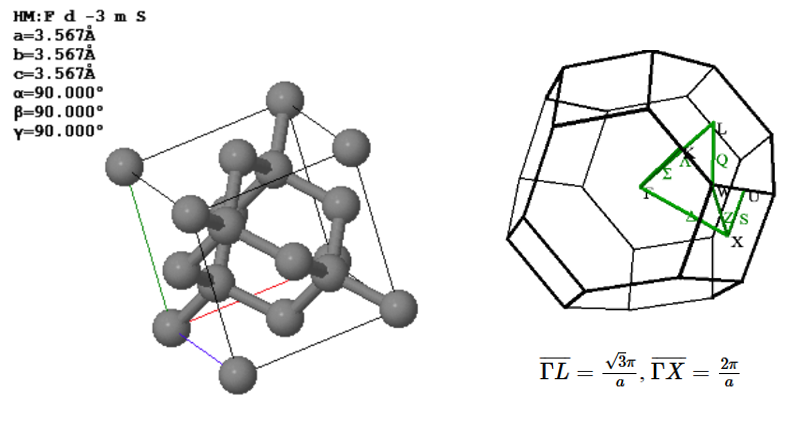
Diamond has an fcc Bravais lattice. There are two atoms in the basis.
(a) How many $\vec{k}$ vectors satisfy periodic boundary conditions for a diamond crystal 1 cm³? (The lattice constant of the conventional unit cell is $a=3.567$ Å.)
(b) The lattice vibrations can be described in terms of normal modes. How many normal modes does a diamond crystal 1 cm³ have?
(c) Use the empty lattice approximation to sketch approximately the phonon dispersion relation for diamond along $L-\Gamma -X$. Label the energy axis.
(d) How many optical phonon branches does this crystal have?
Solution
Problem 3
The electron density of states for a particular material is given in the following figure. The total electron density is $17 \times 10^{27}$ electrons/m³. The form of the density of states was chosen to make it easy to integrate (by counting squares). The band edges are at integer or half-integer values in eV.
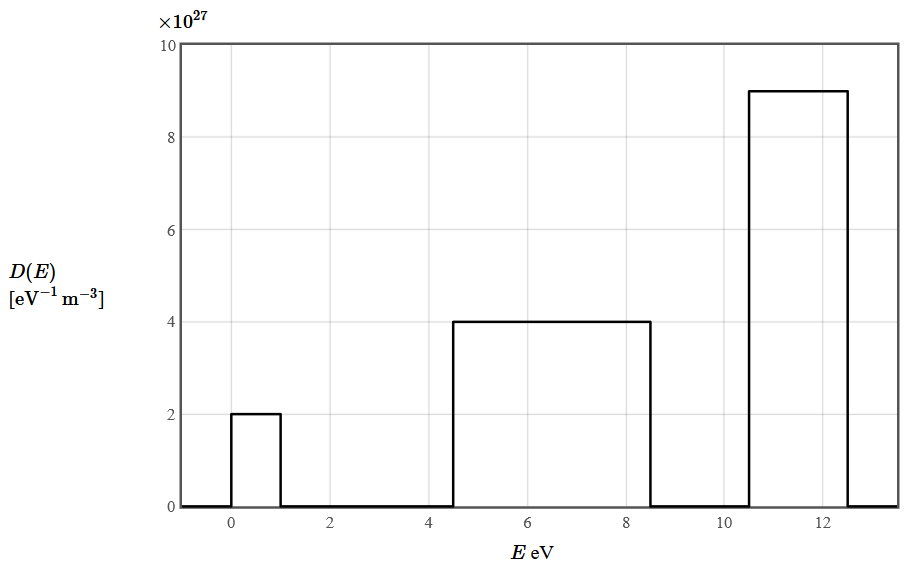
(a) Is this material a metal, an insulator, or a semiconductor?
(b) What is the limiting value of the Fermi energy as the temperature approaches zero?
(c) How could you determine experimentally whether a material is a metal, an insulator, or a semiconductor?
Solution
Problem 4
(a) The electrical conductivity of a crystal is different in the $z-$direction than it is in the $x-$ and $y-$directions. What does this tell you about the crystal structure?
(b) In an electronic band structure diagram, how many electron states are there in each band?
(c) What are the Miller indices of a vector pointing from one bcc Bravais lattice point to another bcc Bravais lattice point? (There is more than one correct answer.)
(d) What is the necessary condition that the Boltzmann approximation is valid for semiconductors?
(e) What is an indirect band gap semiconductor?
Solution