
PHY.K02UF Molecular and Solid State Physics
|
| |||
PHY.K02UF Molecular and Solid State Physics | ||||
A two-dimensional periodic function repeats in two directions. A translation by any vector $u\vec{a}_1 + v\vec{a}_2$ will move to an equivalent point in the pattern. Here $\vec{a}_1$ and $\vec{a}_2$ are the primitive lattice vectors and $u$ and $v$ are integers. The two primitive lattice vectors need not be orthogonal.
The periodicity conditions for a two-dimensional periodic function $f(\vec{r})$ are,
$$f(\vec{r}) = f(\vec{r}+\vec{a}_1),\\f(\vec{r}) = f(\vec{r}+\vec{a}_2).$$Such functions can be written as a Fourier series in terms of sines and cosines,
$$f(\vec{r})= c_0 +\sum\limits_{\vec{G}}\left(c_{\vec{G}}\cos\left(\vec{G}\cdot\vec{r}\right) + s_{\vec{G}}\sin\left(\vec{G}\cdot\vec{r}\right)\right),$$or more compactly as complex exponentials,
$$f(\vec{r})= \sum\limits_{\vec{G}}f_{\vec{G}}\exp\left(i\vec{G}\cdot\vec{r}\right).$$Where $\vec{G}$ are the reciprocal lattice vectors. Since the reciprocal lattice vectors must satisfy the periodicity conditions,
$$\sin(\vec{G}\cdot\vec{r}) = \sin(\vec{G}\cdot(\vec{r}+\vec{a}_1)),\\\sin(\vec{G}\cdot\vec{r}) = \sin(\vec{G}\cdot(\vec{r}+\vec{a}_2)),$$the $\vec{G}$s must have the properties,
$$\vec{G}\cdot\vec{a}_1 = 2\pi h,\\ \vec{G}\cdot\vec{a}_2 = 2\pi k,$$where $h$ and $k$ are integers. These conditions will be satisfied if the reciprocal lattice vectors have the form, $\vec{G} = h\vec{b}_1 + k\vec{b}_2$ where $\vec{a}_i\cdot \vec{b}_j = \delta_{ij}$.
A periodic function consists of a primitive unit cell that is repeated on a Bravais lattice. There are five Bravais lattices in two dimensions.
 Oblique |  Rectangular | 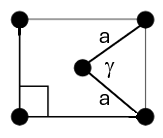 Centered rectangular |  |
 |
A Bravais lattice can be specified by giving two primitive lattice vectors, $\vec{a}_1$ and $\vec{a}_2$. The lattice parameters (or lattice constants) in two dimensions are the lengths of the primitive lattice vectors $a = |\vec{a}_1|$, $b=|\vec{a}_2|$, and the angle $\gamma$ between the primitive lattice vectors, $\cos\gamma = \vec{a}_1\cdot\vec{a}_2/(ab)$. For convenience $\vec{a}_1$ can be chosen to point in the $x-$direction,
$$\vec{a}_1 = a\,\hat{x},\qquad\vec{a}_2 = b\cos\gamma\,\hat{x} + b\sin\gamma\,\hat{y}.$$Centered rectangular is the only Bravais lattice in two dimensions where the conventional unit cell is not equivalent to the primitive unit cell. The primitive unit cell of centered rectangular is a rhombus with four equal sides and angles that are not $\gamma \ne 60^\circ$ or $90^\circ$ or $120^\circ$. In the figure below, the black lines indicate the primitive unit cells and the red lines indicate the conventional unit cell. The conventional unit cell contains two Bravais lattice points and has twice the area of the primitive unit cell.
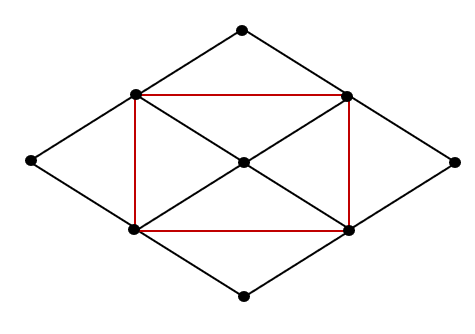
Conventional unit cells are sometimes used simply because it is easier to think about directions on a rectangular lattice than if the lattice is comprised of rhombuses.
The primitive lattice vectors in reciprocal space can then be calculated using the conditions,
$$\vec{a}_i\cdot\vec{b}_j=2\pi\delta_{ij}.$$These are four equations and four unknowns $(b_{1x},\,b_{1y},\,b_{2x},\,b_{2y})$. In terms of $a,\,b,$ and $\gamma$, (and assuming that $\vec{a}_1$ points inthe $x$-direction) the primitive lattice vectors in reciprocal space are,
$$\vec{b}_1 = \frac{2\pi}{a}\,\hat{k_x}-\frac{2\pi\cos\gamma}{a\sin\gamma}\,\hat{k_y},\qquad\vec{b}_2 = \frac{2\pi}{b\sin\gamma}\,\hat{k_y}.$$A two-dimensional periodic function is plotted below. The form can be used to adjust the ratio $b/a$ and the angle $\gamma$. It is possible to specify four Fourier coefficients $f_{h,k}$. The Fourier coefficients are set such that $f_{\vec{G}} = f^*_{\vec{G}}$ so that the periodic function is real. All other Fourier coefficients are set to zero.
|
$\vec{a}_1=1\,\hat{x}$ $\vec{a}_2=$ $\hat{x} + ($ $) \hat{y}$ $\vec{b}_1=$ $\hat{k}_x + ($ $)\hat{k}_y$ $\vec{b}_2=$ $ \hat{k}_y$ |
If all of the Fourier coefficients $f_{\vec{G}}$ have the same value, the resulting periodic function has a peak at every Bravais lattice point. This is the analog to the comb function in one dimension.
Determining the Fourier coefficients
If the periodic function $f(\vec{r})$ is known, the Fourier coefficients $f_{\vec{G}}$ can be determined by multiplying both sides of a Fourier series by $\exp (-i\vec{G}'\cdot \vec{r})$ and integrating over a primitive unit cell.
$$\int\limits_{\text{unit cell}}f(\vec{r})\exp (-i\vec{G}'\cdot \vec{r})d\vec{r} = \sum\limits_{\vec{G}}\int\limits_{\text{unit cell}}f_{\vec{G}}\exp (-i\vec{G}'\cdot \vec{r})\exp (i\vec{G}\cdot \vec{r})d\vec{r}$$On the right-hand side, only the term where $\vec{G} = \vec{G}'$ contributes and the integral evaluates to $f_{\vec{G}}$ times the volume $V_{\text{uc}}$ of the primitive unit cell.
$$f_{\vec{G}} = \frac{1}{V_{\text{uc}}}\int\limits_{\text{unit cell}}f(\vec{r})\exp (-i\vec{G}\cdot \vec{r})d\vec{r} $$Example 1: Checkerboard pattern
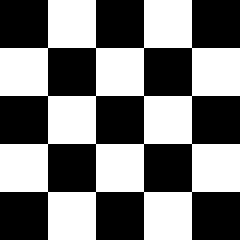
Consider a two-dimensional function that has a constant value $C$ on the black squares of a checkerboard and has a value 0 on the white squares of a checkerboard. The lattice constant $a$ is from the center of a black square to the center of a neighboring black square, so the sides of a black square are $\sqrt{2}a/2$. This is a two-dimensional analog to the square wave problem that was solved in one dimension.
This function can be expressed as a Fourier series,
$$f(\vec{r})=\sum \limits_{\vec{G}} f_{\vec{G}}\exp \left(i\vec{G}\cdot\vec{r}\right).$$We choose the origin to be in the middle of one of the black squares. The Wigner-Seitz cell contains one black square, so we integrate over the square to determine the Fourier coefficients,
$$f_{\vec{G}} = \frac{C}{a^2}\int\limits_{-\sqrt{2}a/4}^{\sqrt{2}a/4}\int\limits_{-\sqrt{2}a/4}^{\sqrt{2}a/4}\exp (-i\vec{G}\cdot \vec{r})dxdy. $$By rewritting the exponential factor,
$$f_{\vec{G}} = \frac{C}{a^2}\int\limits_{-\sqrt{2}a/4}^{\sqrt{2}a/4}\int\limits_{-\sqrt{2}a/4}^{\sqrt{2}a/4}\exp (-iG_xx)\exp (-iG_yy)dxdy, $$the integrals can easily be performed,
$$f_{\vec{G}} = \frac{C}{a^2}\frac{\left(\exp (-iG_x\sqrt{2}a/4)-\exp (iG_x\sqrt{2}a/4)\right)\left(\exp (-iG_y\sqrt{2}a/4)-\exp (iG_y\sqrt{2}a/4)\right)}{-G_xG_y}. $$Using Euler's formula,
$$f_{\vec{G}} = \frac{C}{a^2}\frac{\left(\cos (-G_x\sqrt{2}a/4)+i\sin (-G_x\sqrt{2}a/4)-\cos (G_x\sqrt{2}a/4)-i\sin (G_x\sqrt{2}a/4)\right)\left(\cos (-G_y\sqrt{2}a/4)+i\sin (-G_y\sqrt{2}a/4)-\cos (G_y\sqrt{2}a/4)-i\sin (G_y\sqrt{2}a/4)\right)}{-G_xG_y}. $$The cosine terms cancel out and the final result is,
$$f_{\vec{G}} = \frac{4C}{a^2}\frac{\sin (G_x\sqrt{2}a/4)\sin (G_y\sqrt{2}a/4)}{G_xG_y}. $$
Example 2: Circles on a 2-d Bravais lattice
Consider a periodic function defined by non-overlapping circles arranged on a 2-D Bravais lattice.
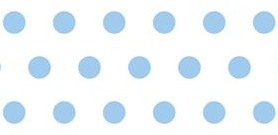
A function $f$ is defined such that it has a constant value $C$ inside the circles and is zero outside the circles. As long as the circles do not overlap, a primitive unit cell can be defined so that the circle at the origin lies entirely within the primitive unit cell. Since the function $f$ is zero outside the circle, we just need to integrate over the circle. The Fourier coefficients $f_{\vec{G}}$ are given by,
$$f_{\vec{G}} = \frac{C}{V_{\text{uc}}}\int\limits_{\text{circle}}\exp (-i\vec{G}\cdot \vec{r})d^2r = \frac{C}{V_{\text{uc}}}\int\limits_{0}^R\int\limits_{-\pi}^{\pi}\left(\cos (|G|r\cos\theta)- i\sin(|G|r\cos\theta)\right)rd\theta dr$$Here $R$ is the radius of the circle. Performing the integral over $\theta$.
$$f_{\vec{G}} = \frac{2\pi C}{V_{\text{uc}}}\int\limits_{0}^RrJ_0(|G|r)dr$$Here $J_0$ is the zeroth-order Bessel function. Integrating over $r$ yields,
$$f_{\vec{G}} = \frac{2\pi C}{V_{\text{uc}}}\frac{RJ_1(|G|R)}{|G|}$$Here $J_1$ is the first-order Bessel function. As long as the circles do not overlap, the Fourier series for circles repeated on any 2-D Bravais lattice is,
$$f(\vec{r})=\frac{2\pi CR}{V_{\text{uc}}}\sum \limits_{\vec{G}} \frac{J_1(|G|R)}{|G|}\cos \left(i\vec{G}\cdot\vec{r}\right).$$The sine terms cancel out since $f(\vec{r})$ is an even function.
Example 3: 2-d comb = Bravais lattice
A Bravais lattice function consists of a $\delta -$function at every Bravais lattice point,
$$f_{\text{BL}}(\vec{r}) = \sum\limits_{uv}\delta(\vec{r}-\vec{T}_{uv}).$$Here, $\vec{T}_{uv} = u\vec{a}_1 + v\vec{a}_2$ is a translation vector. This is a periodic function so it can be expressed as a Fourier series,
$$f_{\text{BL}}(\vec{r}) = \sum\limits_{uv}\delta(\vec{r}-\vec{T}_{uv})= \sum\limits_{hk}f_{\vec{G}_{hk}}\exp(i\vec{G}_{hk}\cdot\vec{r}).$$To determine the Fourier coefficients $f_{\vec{G}_{hk}}$, multiply by $\exp(-i\vec{G}_{hk}'\cdot\vec{r})$ and integrate over a unit cell.
$$\int d\vec{r} \exp(-i\vec{G}_{hk}'\cdot\vec{r})\sum\limits_{uv}\delta(\vec{r}-\vec{T}_{uv})= \int d\vec{r}\exp(-i\vec{G}_{hk}'\cdot\vec{r})\sum\limits_{hk}f_{\vec{G}_{hk}}\exp(i\vec{G}_{hk}\cdot\vec{r}).$$There is only one $\delta -$function at $\vec{r}=0$ in the primitive unit cell, so the left side evaluates to 1. The right side evaluates to $f_{\vec{G}_{hk}}$ times the area of the unit cell $A_{\text{uc}}$.
$$f_{\vec{G}_{hk}} = \frac{1}{A_{\text{uc}}}.$$All of the Fourier coefficients have the same value. The Bravais lattice function is,
$$f_{\text{BL}}(\vec{r})=\frac{1}{A_{\text{uc}}}\sum\limits_{hk}\exp(i\vec{G}_{hk}\cdot\vec{r}).$$For every $\vec{G}$ in the sum, there is a $-\vec{G}$, so the imaginary parts cancel out. The sum of the terms for $\vec{G}$ and for $-\vec{G}$ is,
$$\cos(\vec{G}\cdot\vec{r}) + i\sin(\vec{G}\cdot\vec{r}) + \cos(-\vec{G}\cdot\vec{r}) + i\sin(-\vec{G}\cdot\vec{r})=2\cos(\vec{G}\cdot\vec{r}).$$The comb function can be written just in terms of cosines,
$$f_{\text{BL}}(\vec{r})=\frac{1}{A_{\text{uc}}}\sum\limits_{hk}\cos(\vec{G}_{hk}\cdot\vec{r}).$$At every Bravais lattice point, $\vec{r}=u\vec{a}_1+v\vec{a}_2$, so
$$\cos(\vec{G}_{hk}\cdot\vec{r})=\cos\left((h\vec{b}_1+k\vec{b}_2)\cdot(u\vec{a}_1+v\vec{a}_2)\right)=\cos\left(2\pi (hu+kv)\right) = 1.$$All of the terms add coherently at the Bravais lattice points, producing a very high peak there, while the different wavelengths cause destructive interference between the Bravais lattice points. When the button further up on this page is pushed, the peaks are not very sharp because the indices $h$ and $k$ are restricted to the range $-1,0,1$.
Fitting a 2-d periodic function to data points
A two-dimensional Discrete Fourier Transform can be used to find a periodic function that goes through a two-dimensional set of data points.